
'Here in Delhi, the Modi government is supposedly looking at 'options' to hit back at Pakistan in any whichever way it can, while in Washington, the Obama administration is looking for ways to strengthen US military cooperation with Pakistan,' says Ambassador M K Bhadrakumar.

Friday's incident at Herat has dampened somewhat the spirit behind the invitation. It reminds Modi much before he officially becomes prime minister, of the challenge that awaits his government, says Sheela Bhatt/Rediff.com
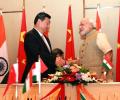
'China's actions at the NSG will certainly taint India-China bilateral relations and enhance suspicion of China's intentions. A fresh clear-eyed and objective evaluation of the India-China relationship is necessary, especially as India tries to correct adversely balanced bilateral economic ties and the two countries engage over the long-term,' says Jayadeva Ranade.
Four Indians and an American, were killed during the five-hour long siege that ended early Thursday morning.

India on Thursday sought strengthening of SAARC monitoring desks on terrorism and drugs, underlining that illicit funds generated from narcotics and fake currency networks are being fed into supporting terror activities

'Trade cannot take place when there is no trust.'

The outcome of the Bangkok NSA-level talks underscores that Pakistan has got exactly what it wanted -- talks at different levels, talks on Kashmir, talks on mutual concerns regarding terrorism, talks on ceasefire on the border. What if any has been India's gains remains unexplained, says Ambassador M K Bhadrakumar.
'Kashmir belongs to us all, even if we differ with each other.' 'Statesmanship demands that we sit together and let the left, right and centre of the political spectrum converge on the solution,' says former MP Tarun Vijay.

It is in Prime Minister Narendra Modi Modi, officials in Washington believe, US President Barack Obama has found an Indian leader who is willing to walk the talk to realise the common goals of the two countries. Lalit K Jha reports

India has strongly hit back at Pakistan, saying the "sell-by date" of the country's "anachronistic approach" is long over and there is absolutely no support in the world body for claims on Kashmir by a nation that established itself as a "global epicenter" of terrorism.
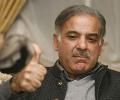
In an interview, Chief Minister of the Punjab province in Pakistan and the Pakistan prime minister's brother, Shahbaz Sharif, says that strategic issues go hand in hand with trade normalisation
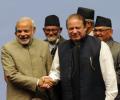
'Modi has said he has been made the PM of India not to do small things but big things. What bigger thing can there be than to have peace with Pakistan and in the neighbourhood?'

Pakistan called in the Army to restore order after violent clashes.

Immediately after India launched its surgical strikes, sources said, it had informed the US of its action.

'I have never seen the Kashmiris in a more conciliatory mood or a more defensive and reasonable mood than I did when I went there in May. All of them said, "raasta nikaliye".' 'Farooq Abdullah has said hundreds of times that the LoC has to be recognised as the international boundary. So that is where the solution lies, it lies on the LoC.' A S Dulat, former RAW chief, explains why he is perplexed by the Modi government's decision to call off foreign secretary-level talks with Pakistan.
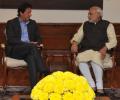
'Modi loves to keep others guessing and basks in the media glare, both traits that are politically helpful but are inimical to stable relations, especially in the fragile Indo-Pak equation.'

Girls in the Kashmir valley hurling defiance at the security forces will detract from the legitimacy of India's response and its standing in the world, says Ajai Shukla.

''There is the perennial worry in the Indian mind regarding the US 'hyphenating' India and Pakistan. Frankly, this is a completely nonsensical hypothesis. The US has always 'hyphenated' India and Pakistan and it couldn't have been otherwise,' says Ambassador M K Bhadrakumar.
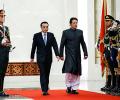
'Imran cannot escape responsibility for providing a mask to the Pakistan army to engage in unlawful activities and to wage aggression after India retaliated to the terrorist attack,' says Ambassador T P Sreenivasan.

'By beheading an Indian soldier, the Pakistan army has demonstrated its proclivity for barbaric medievalism.' 'The strategies adopted and the punishment inflicted by India must be made progressively more stringent with every new act of terrorism till the cost becomes prohibitive for Pakistan,' says Brigadier Gurmeet Kanwal (retd).

'The clique that runs that country is treating us like suckers. We are very foolish, giving people money who involve themselves in activity that's harmful to America.' 'When you look at the cold hard facts, Pakistan is not an ally to the United States. They have facilitated, they have encouraged, they have been a protector of enemies.'

Delegates of a bilateral peace delegation urge the prime ministers of Pakistan and India to resume dialogue for peace and full normalisation of relations.

'While the meeting on December 6th was perfectly legal, was it ethical?' asks Colonel Anil A Athale (retd).

'He could indeed survive [the no confidence vote] even as he faces his biggest political test.'
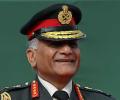
Alleging that V K Singh had not only damaged the reputation of the army but also of India, Union Minister Farooq Abdullah on Saturday said the former army chief should be stripped of the title of Colonel of Rajput Regiment for "lying".
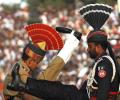
'Despite Modi's high-flown rhetoric about good-neighbourly relationships in South Asia, he lacks a road map how to proceed -- be it with Bangladesh or with Sri Lanka and Pakistan... But a deeper question arises here: Did he duck on his own accord or under the diktat from the RSS, asks Ambassador M K Bhadrakumar.
'Pakistanis are very clever in manipulating us,' former Bush administration official tells US lawmakers.

The minister said the terrorist groups created by Pakistan is not only harming India, but also hurting its neighbours.

'It would not be incorrect to say that the Chinese-Pakistani strategy of containing India began in the aftermath of the 1965 war.'

The clichd path of conducting 'uninterrupted and uninterruptable' bilateral dialogue with Pakistan to improve ties remains unimplemented and un-implementable under prevailing circumstances that are unlikely to alter in the near future, says Rahul Bedi.

'Pakistan persists in the belief that such attacks will enable it to obtain the territory it covets. Their plans will not succeed.'
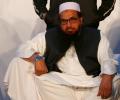
The perpetrators of the 2008 Mumbai attack, who shot dead 166 people, had confessed to details that should have been enough to hang him, but Pakistan enjoyed his anti-India rhetoric and let him spread his tentacles. A revealing excerpt from Khaled Ahmed's Pakistan's Terror Conundrum.

India's new high commissioner in Islamabad goes to Pakistan at a time when the country is set to face much internal tumult.

'Whether it's investments in Kashmir, building naval facilities, or selling top-of-the-range military equipment, Pakistan could well benefit more under Xi's watch.' 'Do Chinese concerns about the 'Islamisation' of Pakistan give it pause about how quickly to move forward with security and economic projects? At the moment the indication is quite the opposite: China is doubling down on its support to Pakistan, partly because of its fears about where the country is headed.'

'A couple of hours before the H-Hour, the Kupwara division opened small arms and mortar fire on posts opposite its area of operation.' 'This was a diversionary tactic.' 'As Pakistani forces began to react to the firing, special forces teams began to slowly cross the LoC into PoK.' Nitin Gokhale reveals how planning for the surgical strikes began hours after the Uri attack.

Cutting across party lines, all MPs slammed Pakistan for awarding death sentence to Kulbhushan Jadhav.

'Clearly, the Modi government is proving to be far more willing than any previous government in Delhi to hitch India's wagons with the US' regional strategies.'
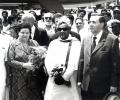
'I was present at a meeting where he decided to permit the IAF to strike at Pakistan positions in Kargil, with the caveat that they should not cross the LoC.' 'Confident that the Indian Army would succeed, Mr Vajpayee was positioning himself to tell the world after the Kargil conflict was won that India did not violate the 'sanctity' of the LoC,' recalls Ambassador G Parthasarathy, who served as India's envoy in Islamabad in that eventful year, 1999.

'The combination of the LeT and the ISI is the most dangerous terrorist challenge in the world because it carries a real and present danger of provoking nuclear war.'

In its 'Right of Reply', India also rejected the 'fanciful and misleading' remarks by the Pakistani envoy to the United Nations.
 © 2026 Rediff.com - Advertise with us - Disclaimer - Privacy Policy - Sitemap - Feedback - About us - Terms of use - Grievances